





Toronto. 11 Feb, Wednesday

Walmart Recalls Great Value Shrimp Due to Potential Radioactive Contamination in the U.S.

The U.S. Food and Drug Administration (FDA) is investigating reports of radioactive contamination—specifically, Cesium-137 (Cs-137)—in frozen shrimp products from an Indonesian company, PT Bahari Makmur Sejati (BMS Foods).

The U.S. Customs and Border Protection (CBP) detected Cs-137 in shipping containers at four major U.S. ports: Los Angeles, Houston, Savannah, and Miami. The FDA then tested several shrimp samples and found Cs-137 in one sample of breaded shrimp. This product was denied entry into the U.S.

The detected level of Cs-137 (about 68 Bq/kg) is well below the FDA’s safety threshold (1200 Bq/kg), so it’s not considered an immediate health hazard. However, long-term exposure to even low levels of radiation can increase the risk of cancer.

The FDA is working with distributors and stores that received shrimp from BMS Foods after the first detection of Cesium-137. Even though those shipments didn’t test positive, the FDA is recommending a recall for safety reasons. The FDA has recommended a recall of certain raw frozen shrimp sold under Walmart’s Great Value brand.
North of the U.S border, the Canadian Food Inspection Agency (CFIA) confirmed to Global News that it is aware of the FDA’s advisory but has not found any evidence that the recalled shrimp was distributed in Canada.

Ohio, the closest to Canada, borders Lake Erie and lies directly across from Southern Ontario, making it the most relevant for Canadians. The other affected states include Alabama, Arkansas, Florida, Georgia, Kentucky, Louisiana, Missouri, Mississippi, Oklahoma, Pennsylvania, Texas, and West Virginia.

Choppy Seas Ahead for the Farmed Shrimp Market

In 2024, a Chinese social media post sparked widespread concern after tests revealed excessive levels of sodium metabisulphite—a chemical preservative—in Ecuadorian Pacific white shrimp sold online. The resulting sulphur dioxide residue exceeded China’s national safety limit of 0.1g/kg, raising health alarms.

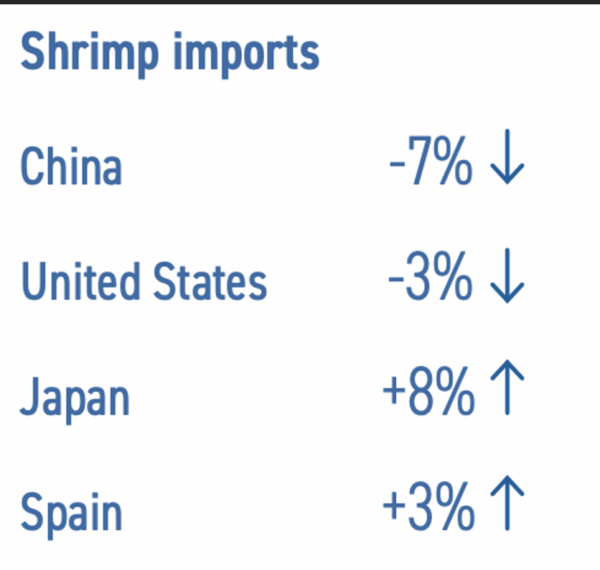
The 2024 global farmed shrimp market experienced a slight contraction, with global imports declining by 1.6% in volume and 5.9% in value. Reduced demand in China and the U.S.—two of the largest markets—drove the overall downturn.

China, which remains the top importer by volume, saw a 7% drop in shrimp imports, largely due to increased domestic production from greenhouse farming.

shrimp

Source: FAO GLOBEFISH | Quarterly Shrimp analysis – May 2025

Information and Analysis on Markets and Trade of Fisheries and Aquaculture Products

However, early 2025 showed signs of recovery in the U.S., with imports rising by 12.6% in the first quarter, driven by seasonal consumption during Lent. However, the current recall by the FDA is likely to damage consumer trust in the protein.

While India, Vietnam, and Indonesia have maintained strong export positions this year, concerns over U.S. tariffs have led some Asian producers to reconsider their production targets.

The S&P Global explains how recent U.S. tariffs are reshaping the global shrimp market, particularly favouring Ecuador over India.

On August 7, 2025, the Trump administration imposed steep tariffs on major shrimp-exporting countries: India (25%), Ecuador (15%), Indonesia (19%), and Vietnam (20%).

Facing steep U.S. tariffs under President Donald Trump’s trade policies, many shrimp farmers in India are considering exiting the industry entirely. Indian exporters lowered the rates offered to shrimp farmers by nearly 20%. A 25% tariff on imports from India is already in place, the highest among major economies, with another 25% levy starting August 27. These tariff shocks are erasing profits for over 300,000 farmers in the state of Andhra Pradesh, India.

As reported by Reuters, India’s shrimp farmers and exporters primarily target the US , the largest market, supplying clients such as Walmart. In the previous year, India’s total seafood exports reached $7.4 billion, with shrimp constituting 40% of this value.

The uncertainty surrounding future trade relations and the financial strain caused by the tariffs have led to reduced stocking of shrimp ponds and a slowdown in production. Industry leaders warn that if the situation continues, India’s shrimp sector could shrink significantly, affecting thousands of livelihoods and disrupting global supply chains.

These tariffs have made Ecuadorian shrimp more competitive in the U.S. market, while Indian exports—especially value-added products like peeled and deveined shrimp—have been sidelined due to higher costs and uncertainty.

Compared to India, Ecuador faces a 15% tariff on exports to the U.S., which enhances its competitiveness.

As a result, Ecuadorian shrimp exports to the U.S. surged by nearly 44% in June, with suppliers adjusting pricing and production to fill the gap left by India.

Shrimp Prices: Cocktails and Coconut Shrimp could get expensive

Ecuador is currently encountering challenges in expanding its processing capacity to keep up with the increasing demand for value-added shrimp products. Environmental concerns also add pressure. Over 25% of shrimp farms operate in mangrove areas, contributing to deforestation and community displacement. Legal efforts to regularize previously illegal farms may improve oversight but also signal the scale of unregulated expansion

Despite these obstacles, recent proposals from Ecuador have included price increases, particularly in segments such as value-added presentations and medium to high-size shrimp.

This indicates a strategic response to market pressures, although scaling up production remains a critical issue to capitalize on emerging opportunities in the shrimp industry fully.

According to an exporter, certain products like cooked shrimp are expected to become so costly that consumers will eventually cease purchasing them altogether. This situation highlights how rising prices can significantly impact demand, potentially leading to reduced availability and altered market dynamics.

Some exporters are running night shifts to keep up, but delays of up to 60 days are being reported. Meanwhile, U.S. importers are passing on the increased costs to consumers, raising fears that shrimp may become too expensive, potentially reducing overall consumption.

YOU MAY ALSO LIKE